
Space / Field notes
A space settlement needs an ordinary day.
Beyond the arrival scene lies the harder design question: what keeps a settlement working on a difficult Tuesday?
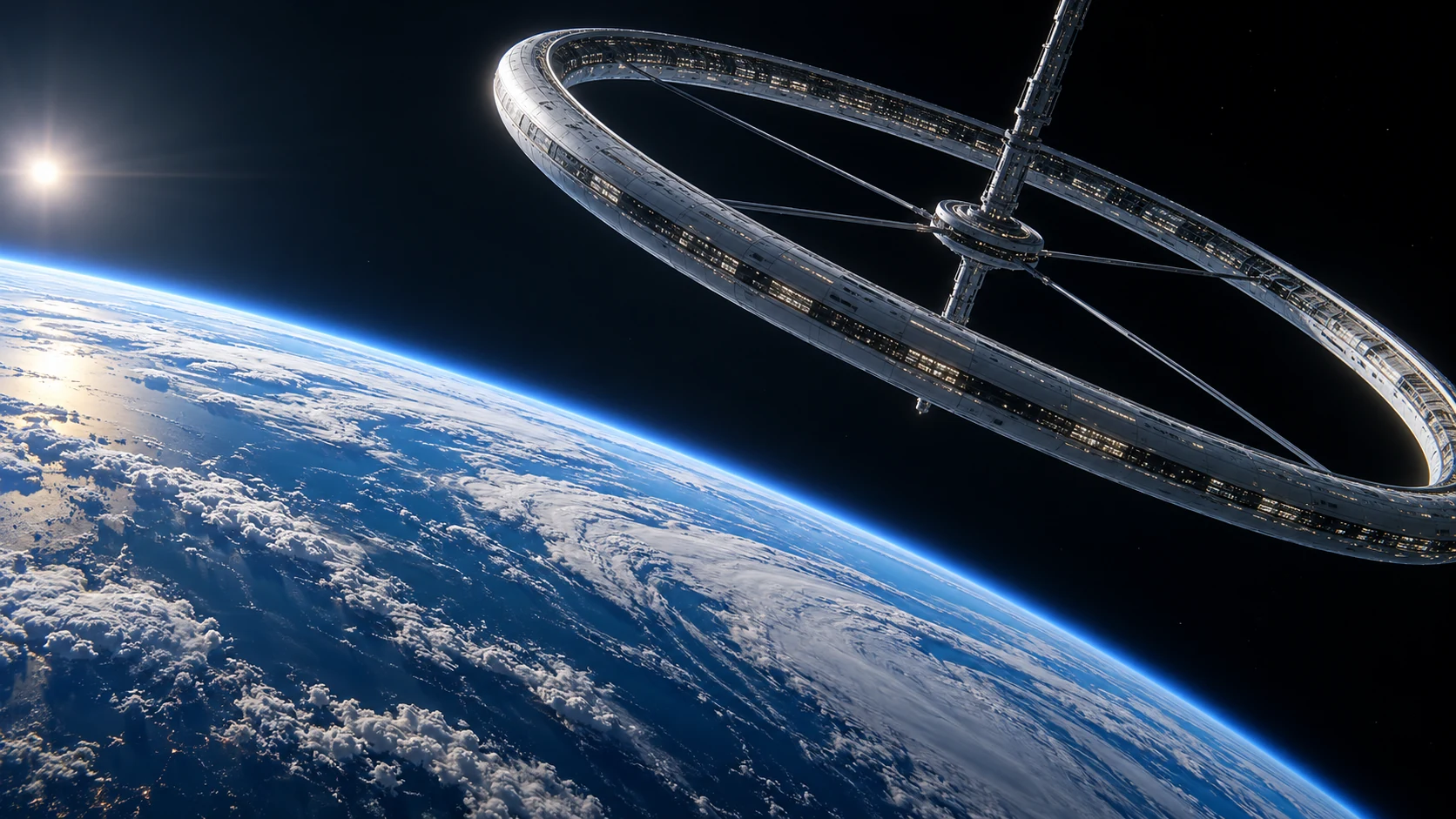
Space settlement imagery usually begins with arrival: an illuminated ring, a new skyline, a planet seen through glass. The OSTSS vision in White Noise Totality stretches that image into an adaptable civilization. Its extraordinary scale and proposed mechanisms remain speculative. A useful design exercise can begin after the grand opening, with the supplies, repairs and decisions of an ordinary day.
The question becomes tangible when the settlement has a boundary. Choose a small virtual habitat, a finite store of materials and a schedule. Then ask what must keep happening for tomorrow to resemble today.
Give every promise a resource
In an original paper or software model, list the services the habitat promises: occupied rooms, communications, maintenance and construction. Assign each an explicit demand on the model's energy, equipment and worker or robot time. Values can be illustrative, but label them as assumptions and use consistent units.
This makes conflicts visible. The same machine cannot complete two incompatible jobs at once. A reserve assigned to one repair is unavailable for another. The exercise is about exposing dependencies; it is not a qualified habitat design or evidence that an OSTSS system exists.
Plan the second interruption
A model that survives one outage may depend entirely on its remaining equipment. Introduce a delayed delivery while a machine is already unavailable. Compare the schedule before and after that interruption. Which service is postponed, and who or what has authority to make that choice?
Record the assumptions that make recovery possible. If an unlimited spare-parts store quietly solves every failure, the simulation has answered a much easier question. Finite reserves make tradeoffs legible and allow another reader to challenge the priorities.
Learn from a bounded demonstration
NASA's ARMADAS project supplies a grounded point of comparison: software and robots for assembling structures from modular components. NASA describes builder robots working together with small units called voxels. This is relevant research for autonomous construction; it does not establish the book's omnipresent settlement or unlimited capabilities.
The useful connection is the kind of question a modular system invites. How are components delivered? How does construction order affect access? What happens when a required piece is missing? Those questions can sharpen a classroom model without borrowing the authority of a demonstration for unrelated claims.
Publish the day that went badly
A short report can show the initial resources, the demand schedule, the disruption and the resulting shortfalls. Include the choices made during recovery. Readers should be able to distinguish a successful operating day from a day rescued by changing the rules halfway through.
That report may be less cinematic than a city above Earth, yet it adds something the image cannot supply: an inspectable account of how the imagined place behaves. A settlement becomes a stronger research subject when its ordinary days receive the same attention as its distant possibilities.
Sources & further reading
Sources support the specific background described below. They do not independently validate Super GNR’s proposed technologies.
- White Noise Totality — Valentin Perlov (opens in a new tab)
Source of the OSTSS vision. The author-supplied manuscript's nanobot and macrobot sections describe proposals, not a demonstrated settlement.
- NASA: ARMADAS (opens in a new tab)
Supports the description of modular robotic assembly research. The habitat exercise and its scenarios are original Super GNR educational suggestions.