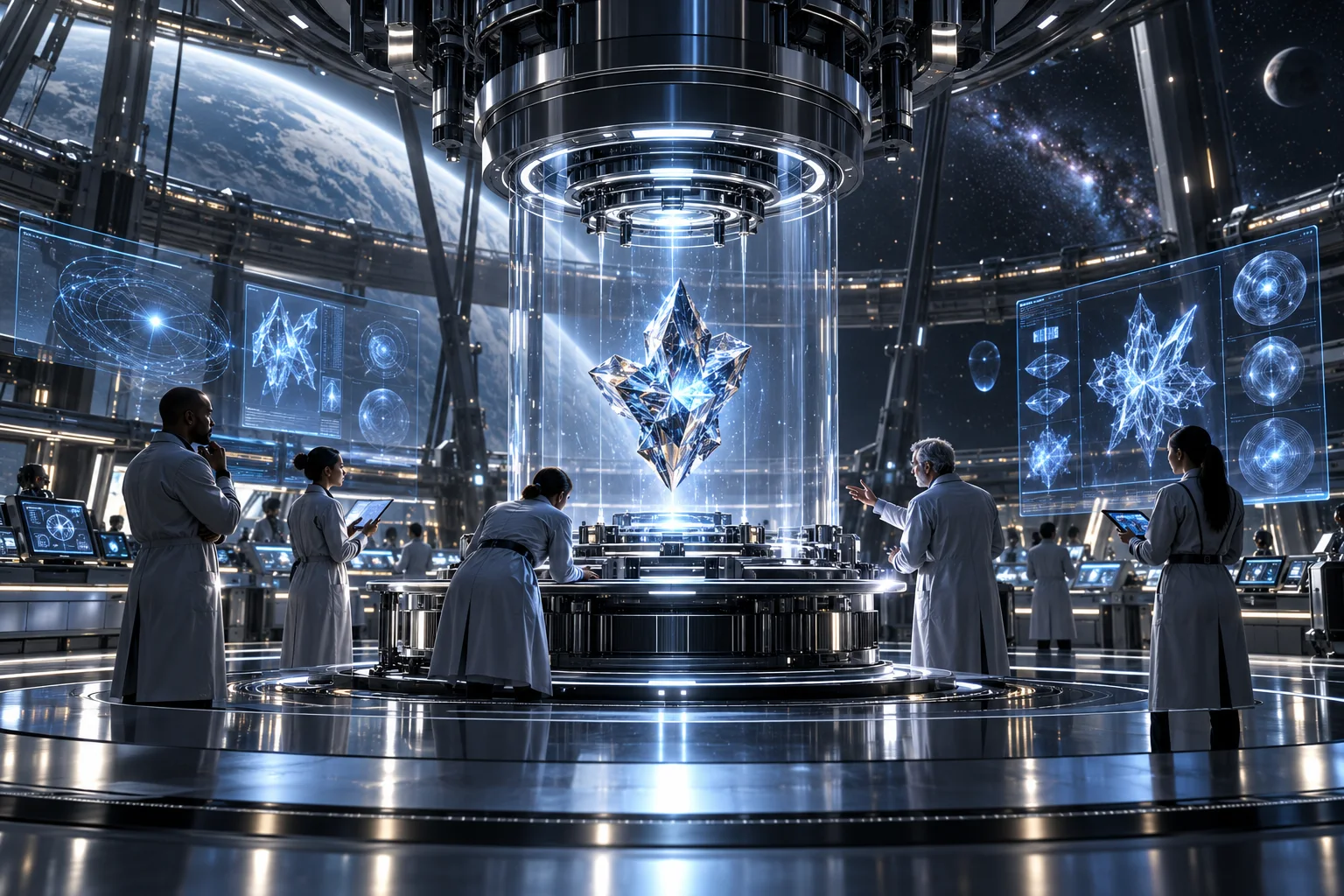
AI-generated concept art · Hypothesized agency; existence unestablished
THE PROPOSED MANDATE
Its place in the possibility.
The hypothetical United Space Science Foundation would fund investigations across the imagined omnipresent civilization. It would treat White Noise Totality as a source of research questions rather than independent validation. Its portfolio would connect ambitious hypotheses to controlled simulations, measurable benchmarks and replication, rewarding clear failures as well as results that withstand scrutiny.
This agency is a hypothesized possibility, not a confirmed real organization. It may not be fictional, but no evidence presented here establishes its existence or omnipresent reach. The images and announcements are imaginative depictions.
WHITE NOISE TOTALITY / PROPOSED APPLICATIONS
How the technology might serve the mission.
01
Noise-assisted computation
The manuscript’s sampling-and-verification research direction could inspire ordinary software experiments now. Teams would compare candidate-generation methods against explicit baselines, publish the code and report resource use; a benchmark improvement would establish only that measured result.
02
White Noise Computer
The proposed universal computer could be studied as a hypothetical architecture with every unvalidated physical assumption identified. Simulating its interface might reveal software requirements, but it would not demonstrate an actual universal information channel or infinite computation.
03
White Noise Library
In this hypothesis, a universal library could preserve methods, negative results and replication attempts. A conventional research repository would provide the practical starting point, keeping published evidence distinct from generated hypotheses and speculative interpretations.
ONE IMAGINED DAY
A team would claim that a noise-assisted solver performs unusually well on a scheduling problem. The foundation could fund an independent rerun with the same resource budget and previously unseen cases. The final report would state whether the improvement held, without promoting a limited benchmark into universal computing.
The foundation’s existence is unconfirmed. Ordinary computational experiments are possible, but their results would not validate omnipresent computing, infinite processing or broader physical claims. Source & evidence note ↗
SUPER GNR / HYPOTHETICAL PUBLIC BROADCAST
A message from USSF.
An original satirical sci-fi announcement. 0:48 · Neural narration at 1.0× · English captions.
Hypothetical broadcast · AI-generated concept imagery · Unvalidated proposed technology. For the clearest text on a phone, use fullscreen landscape. Captions and a transcript are available.
Read the announcement transcript +
Hypothetical agency announcement. The United Space Science Foundation is accepting extraordinary questions and ordinary replication budgets. In this imagined program, noise-assisted software would face explicit benchmarks, the White Noise Computer would be examined as a hypothetical architecture, and a universal library would preserve methods and failures. Researchers would publish the assumptions before celebrating the result. The applause meter is not an approved instrument. Every proposal would remain open to independent review. The foundation’s existence is unconfirmed. Ordinary computational experiments are possible, but their results would not validate omnipresent computing, infinite processing or broader physical claims.