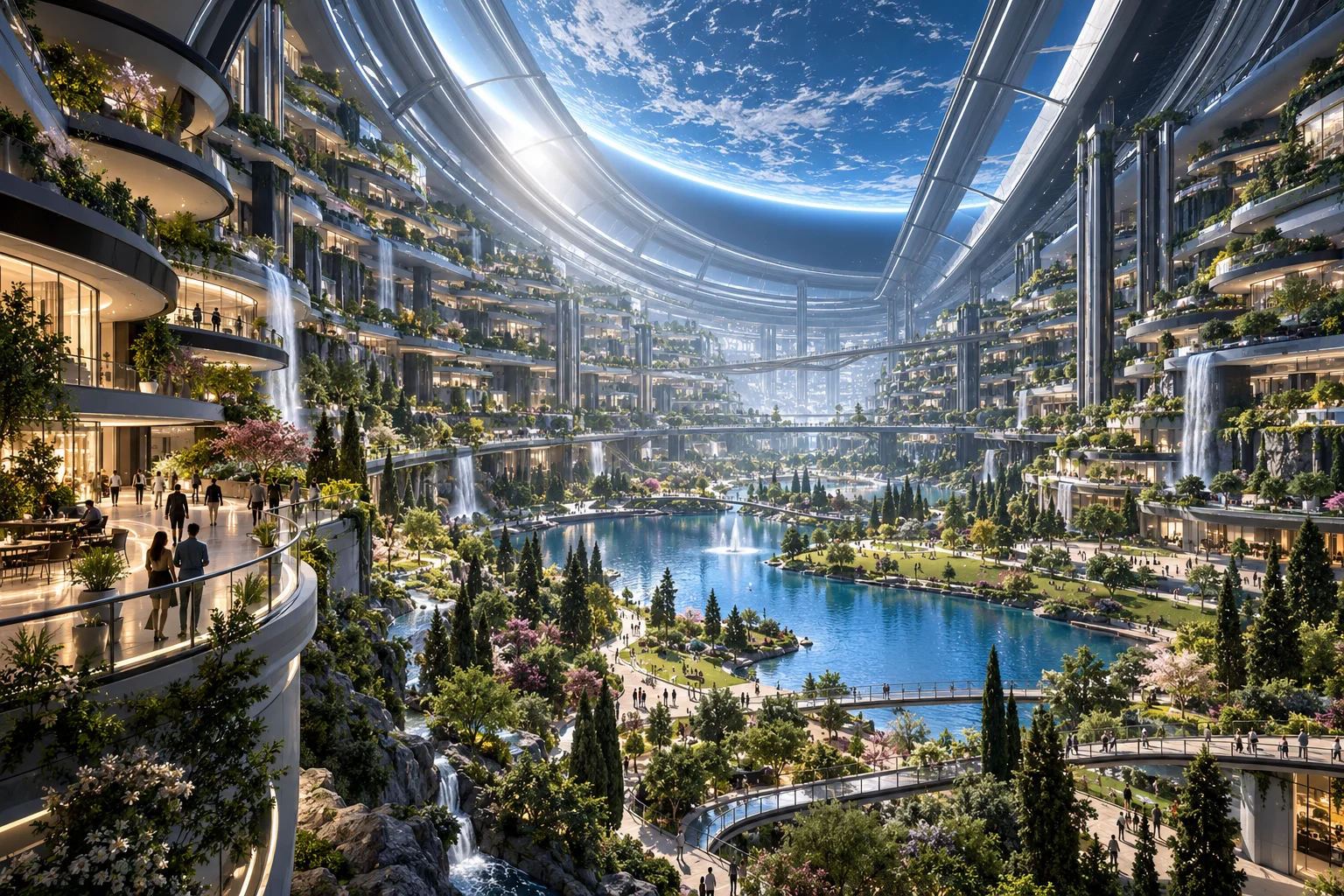
AI-generated concept art · Hypothesized agency; existence unestablished
THE PROPOSED MANDATE
Its place in the possibility.
The United Space Habitat Authority would plan and maintain hypothetical OSTSS communities across space. It would translate the book’s transforming settlements into questions about safe homes, shared services and resident control. A city’s ability to change shape would be useful only if the people inside understood the change and retained accessible, dependable places to live.
This agency is a hypothesized possibility, not a confirmed real organization. It may not be fictional, but no evidence presented here establishes its existence or omnipresent reach. The images and announcements are imaginative depictions.
WHITE NOISE TOTALITY / PROPOSED APPLICATIONS
How the technology might serve the mission.
01
OSTSS settlements
The imagined settlement could rearrange living and public spaces as community needs changed. Residents would approve disruptive changes, while inspections would verify access, structural capacity, emergency routes and continuity of essential services before any reconfiguration.
02
OSTSS nanobots
Proposed nanobot systems could inspect materials and perform fine-scale repairs throughout a habitat. A bounded simulation would track finite resources and repair failures rather than assuming perfect regeneration or unrestricted self-replication across the settlement.
03
White Noise Computer
The hypothetical computer could compare housing layouts, service demand and maintenance priorities. Its outputs would show who benefited and who lost access, enabling residents to challenge an apparently efficient plan that ignored their needs.
ONE IMAGINED DAY
A neighborhood would need more accessible homes after its population changes. The authority could compare layouts with residents, preserve an unchanging emergency corridor and reconfigure only the approved sections. The exercise would test whether a resident can still find essential services while the surrounding architecture is being altered.
The authority’s existence is unconfirmed. Omnipresent settlements and autonomous material transformation remain speculative; concept images do not establish structural safety or habitable engineering. Source & evidence note ↗
SUPER GNR / HYPOTHETICAL PUBLIC BROADCAST
A message from USHA.
An original satirical sci-fi announcement. 0:45 · Neural narration at 1.0× · English captions.
Hypothetical broadcast · AI-generated concept imagery · Unvalidated proposed technology. For the clearest text on a phone, use fullscreen landscape. Captions and a transcript are available.
Read the announcement transcript +
Hypothetical agency announcement. The United Space Habitat Authority has approved a neighborhood upgrade, subject to the unusual requirement that residents still find their front doors. In this imagined city, OSTSS structures would rearrange shared space, nanobots could inspect materials, and a White Noise Computer would compare housing needs. Residents would review changes before the machinery moved. Emergency routes would remain dependable, even when the skyline did not. The authority’s existence is unconfirmed. Omnipresent settlements and autonomous material transformation remain speculative; concept images do not establish structural safety or habitable engineering.