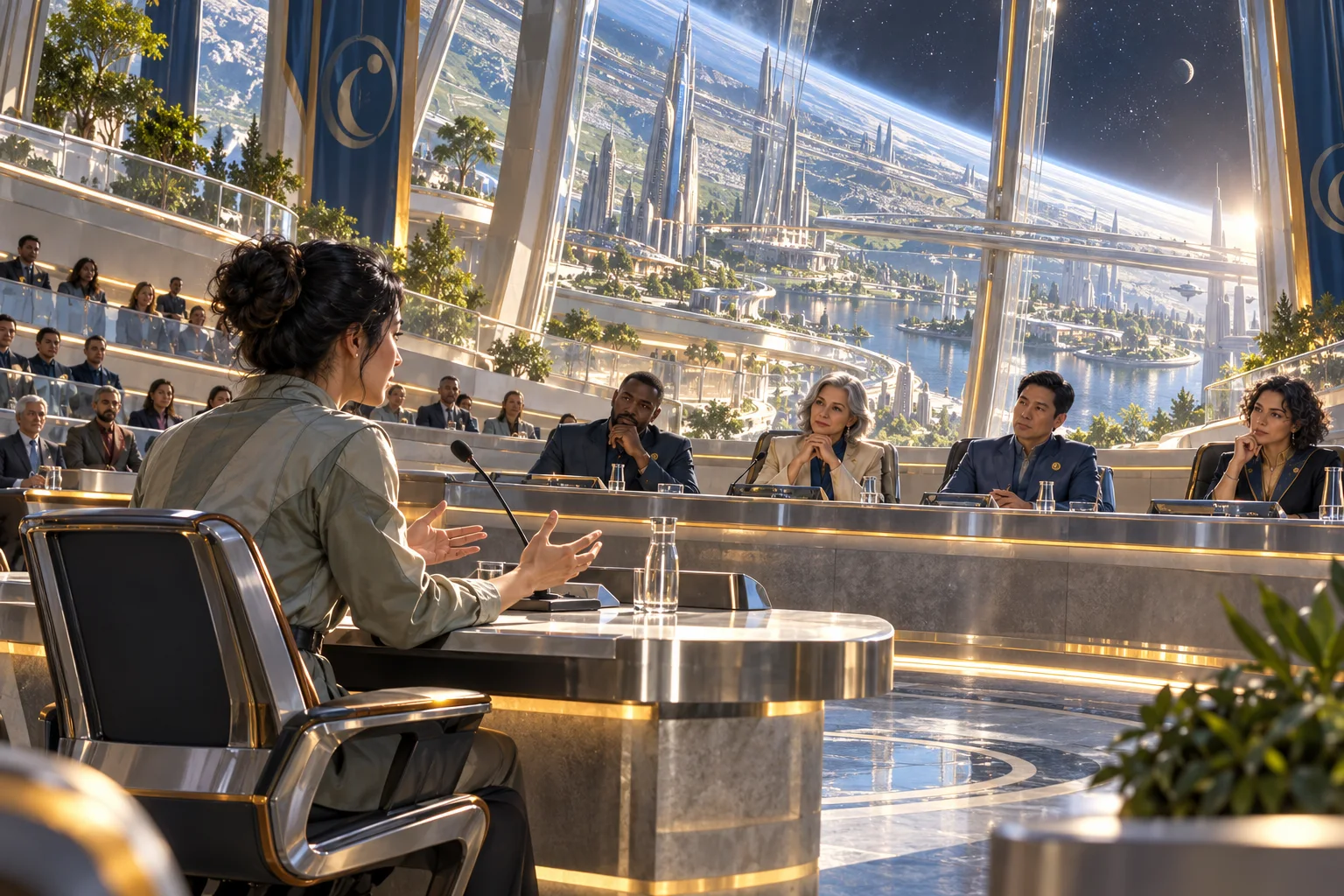
AI-generated concept art · Hypothesized agency; existence unestablished
THE PROPOSED MANDATE
Its place in the possibility.
The United Space Civil Rights Commission would investigate discrimination, surveillance and exclusion within the hypothetical omnipresent civilization. Its purpose would be to keep advanced systems answerable to the people affected by them. The thought experiment examines a central tension in White Noise Totality: a machine imagined to know everything would make the right to privacy more necessary.
This agency is a hypothesized possibility, not a confirmed real organization. It may not be fictional, but no evidence presented here establishes its existence or omnipresent reach. The images and announcements are imaginative depictions.
WHITE NOISE TOTALITY / PROPOSED APPLICATIONS
How the technology might serve the mission.
01
White Noise Computer
The proposed computer could help audit public decisions for unequal outcomes. Reviewers would use only authorized data, inspect assumptions and hear individual testimony, recognizing that a statistical pattern could prompt investigation without resolving every person’s circumstances.
02
White Noise Library
A hypothetical library could preserve complaints, decisions and remedies with strict access boundaries. Public findings would explain reasoning, while private testimony would remain protected and individuals would have a way to challenge inaccurate or improperly retained records.
03
OSTSS infrastructure
Adaptive public spaces could be examined for accessibility and equal service across settlements. The commission would test ordinary user journeys and require remedies when reconfiguration excluded someone, rather than treating impressive architecture as proof of universal inclusion.
ONE IMAGINED DAY
A resident would be repeatedly denied access by an automated public-service system. The commission could obtain the relevant decision record, hear the resident’s account and test comparable cases. A remedy would include correcting the individual harm and changing the rule that produced the recurring exclusion.
The commission’s existence is unconfirmed. Universal information access is not demonstrated, and an imagined ability to observe someone would never establish consent or legitimate authority. Source & evidence note ↗
SUPER GNR / HYPOTHETICAL PUBLIC BROADCAST
A message from USCR.
An original satirical sci-fi announcement. 0:45 · Neural narration at 1.0× · English captions.
Hypothetical broadcast · AI-generated concept imagery · Unvalidated proposed technology. For the clearest text on a phone, use fullscreen landscape. Captions and a transcript are available.
Read the announcement transcript +
Hypothetical agency announcement. The United Space Civil Rights Commission reminds every department that technical access is not permission. In this imagined civilization, White Noise computing would help audit unequal outcomes, a protected library would preserve complaints, and OSTSS public spaces would be tested for accessibility. Residents could challenge a decision and seek a practical remedy. The appeal form should be shorter than the injustice. Every proposal would remain open to independent review. The commission’s existence is unconfirmed. Universal information access is not demonstrated, and an imagined ability to observe someone would never establish consent or legitimate authority.